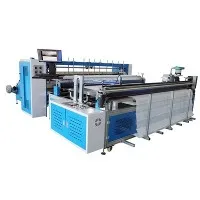
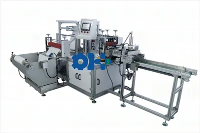
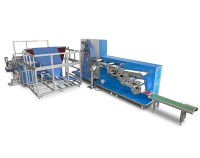
Shoebox shoe cover become the key equipment to ensure environmental cleanliness in the highly hygiene requirements environment such as cleaning rooms, medical facilities and laboratories. With the development of technology, fully automatic and semi-automatic shoe cover manufacturing machinery gradually forms a differentiated competitive pattern. This paper will analyze the core differences from four dimensions: technology principle, production efficiency, material compatibility and intelligence level.
I. Technical principle: Mechanical Linkage vs. Intelligent control
The core technology of semi-automatic shoe cover machine is based on mechanical linkage system, which uses the physical interaction between pedal, gear, spring and so on to wrap shoes. For example, when a user steps on a pedal, the mechanical structure triggers the elastic cord to contract, covering the foot with a pre-fitted shoe cover. The design relies on manual work to trigger the process, and the tightness of the packaging is limited by mechanical structural fixation parameters that make it difficult to adapt to complex shoe shapes (such as high heels and irregularly shaped soles).
On the other hand, the automatic shoe cover manufacturing machinery adopts intelligent sensing and adaptive control technology. Take Nanjing Suneng Automation Equipment Co. Co. Ltd.'s fully automated smart shoe cover machine, which uses infrared or pressure sensors to identify shoe shape and shoe size real time, and uses algorithms to dynamically adjust the wrapping force and angle. Some high-end models even integrate a pneumatic jet system, using negative pressure adsorption to achieve the shoe cover and vamp non-contact bonding, completely solved the traditional mechanical structure of shoe shape.
ii. Production Efficiency: Single-action vs. The production efficiency of Continuous Work semi-automatic machines is limited by the frequency of manual intervention. the Baojiajing semi-automatic shoe cover machine, for example, has a single load of only 60 shoe covers, consumables only after the user uses all the shoe cover can be restocked, leading to frequent downtime in high-frequency use. In addition, the response speed of mechanical structures (usually 0.5-1 second/time) limits the amount of processing per unit of time.
On the other hand, fully autonomous vehicles are continuously operated through modular design and high-speed transmission systems. For example, Ltd.'s fully automatic shoe cover machine supports roll-type consumables, each roll can hold 600 shoe covers. Coupled with a wrapping speed of 300 times per minute, this would meet the continuous usage needs of 300 people. Industrial-scale models incorporate IoT features that allow real-time adjustments of production parameters through remote monitoring. One machine can process up to 5,000 a day, more than 10 times more efficient than semi-autonomous models.
III. Material Compatibility: Single Specification vs. Multi-Specification Compatibility
Semi-automatic models less compatible with consumables. Because of their fixed mechanical structure, they can only be used in shoe covers of specific sizes (e.g., length ≤ 30cm) and materials (e.g., traditional PE film). Packaging problems mechanical jamming blockages may occur due melting point points or thickness when using biodegradable PLA materials or thickened, non-slip shoe covers.
Fully automatic model has achieved a breakthrough in material compatibility through dynamic parameter adjustment technology. Take the Richpeace fully automatic disposable shoe cover machine, with built-in PLC program control and adjustable material rack that automatically adjusts heating temperature (105-150°C adjustable) and tension control to support the production of double/triple elastic belt shoe covers based on the consumables characteristics (e.g. melting point, malleability, etc.). Some models even have material recognition sensors that automatically match the most optimal processing parameters for different materials, such as non-woven fabrics and copper plates.
IV. INTRODUCTION Intellectual level: Basic Functions and? Ecosystem Integration
Semi-automatic models focuses only on basic wrapping needs and lacks scalability. For example, the Ginza semi-automatic shoe only supports foot start operations and consumable replenishment reminders and isnot connected to access control systems, air showers and other equipment, making it difficult to meet the "unmanned" management requirements clean rooms.
On the other hand, fully automated models are moving toward intelligent ecosystem integration. For example:
Data-Driven Optimization: Shenzhen Jiechi Automation Equipment Co., Ltd.'s all-smart shoe sleeve machine gathers production data (such as packaging success rate, consumable consumption rate, etc.) through sensors and uses artificial intelligence algorithms to optimize processing parameters, reducing the scrap rate from 5% to less than 0.3%.
Contactless interaction: Some models employ facial recognition or gesture control technology to avoid the risk of cross-infection;
Eco-friendly extension: high-end models support shoe cover recycling and reuse, through the built-in fragmentation module to convert waste shoe cover into recycled materials, forming a closed-loop production system.
V. Application Scenarios and cost trade-offs
Semi-automatic models still dominate the market for low-frequency use scenarios such as homes and small laboratories due to their low cost and easy maintenance. For example, the Huang Mao fully automatic shoe cover machine (semi-automatic) costs only 300-800 yuan, suitable for users with limited budgets.
Fully automated models have become the first choice for high-frequency use scenarios. In the case of one electronics workshop, Nanjing Sueneng fully automated shoe sheathing machine, while costing more than 20,000 yuan per unit, recouped its investment costs in 18 months by reducing labour costs (saving 2 operators per shift), reducing material waste (90 per cent reduction in scrap rate) and improving cleanliness (particulate matter concentration ≤ 0.5 m/m3).
Epilogue: Technological Iteration drives industry upgrading from mechanical connectivity to intelligent control, from single functionality to ecological integration. The development of shoe cover machines reflects the unremitting pursuit of efficiency, accuracy and sustainability in manufacturing. In the future, with the integration of technologies such as 3D printing and nanomaterials, fully automated shoe cover manufacturing machines will further overcome physical limitations and provide more efficient solutions for cleanroom protection. For businesses, the choice of model requires a combination of usage scenario, budgets and long-term costs to achieve the best balance of technology investment and productivity benefits.
Feb 01, 2026
Analysis On The Core Differentiation Between Fully Automatic And Semi-Automatic Shoe Cover Manufacturing Machines
Send Inquiry
Product Categories
Latest Products