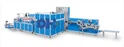
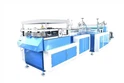
_ Revealing the perfect combination of mechanical automation and materials science _.
In highly hygiene requirements situations, such as medical care, food processing and laboratory settings, traditional manual shoe cover methods are not only inefficient, but can also contaminate the surface of shoe cover through contact. The emergence of fully automatic plastic shoe cover machine has completely changed this situation --through precise mechanical design and intelligent control technology, the whole process of ``shoe wearing → automatic coating → contactless completion"has been realized. So how exactly does this process work? This paper will analyze the technical principle of fully automatic shoe sheathing machine from three core angles: mechanical structure, material application and sensor control.
I. Mechanical Structure: The core function of a a precision deforming fully automatic shoe cover machine is to convert a roll of flat plastic film (e.g., PE or PP material) into a three-dimensional shoe cover suitable for the upper. This process relies on the coordination of multiple mechanical modules:
The feed and Unfolding Module film roll is mounted on the top of the machine. A motor-driven roller rotates to continuously feed the film into the processing area.
The film is kept flat and wrinkle-free during transportation by tension control device for subsequent forming.
Hot Melting and Sealing Module: transfer the film to a heating area, where the hot melt head immediately heats the local material, softens and adheres to it to form a the "bottom seal" for the shoe cover.
This step requires precise temperature control (usually between 100 ° C and150°C) and time to prevent combustion or incomplete sealing.
Cutting Separation Module: After sealing, the high speed blades cuts the film to a predetermined length to form a single shoe cover unit.
The incision is still attached to the remaining membrane, which is then separated by a peeling mechanism and sent to the next stage.
Wrapping and Forming Module: This is the most critical step: the shoe cover is sent near an elastic expansion ring or air pressure jet device.
When the user inserts the shoe, the expansion ring or airflow immediately opens the shoe cover to conform the the shoe's contours.
Some high-end models also feature robotic arms to assist in adjusting the shoe cover's position, ensuring full coverage of the soles and sides.
ii. Material science: efficiency and stability of plastic sheath The Metamorphosis fully automated shoe cover machines depends to a large extent on the selection and processing of plastic sheath materials:
Material Property Requirements
* Scalability: The film must possess a certain elasticity to prevent it from tearing easily when stretched.
:: Heat Melting: It should be able to bond quickly through heating to form an enclosed structure.
• Anti-skid: Anti-skid particles are usually embossed or sprayed on the bottom of the shoe sleeve to increase friction.
Environmental Upgrade Trend
Traditional shoe covers mostly use non-degradable PE/PP materials, but new shoe cover machines now support biodegradable films (such as PLA polylactic acid) or use recycling systems to compress discarded shoe covers into chunks for subsequent treatment.
III. Sensors and smart controls: upgraded from "passive" to "active"
The "intelligence"of fully automatic shoe cover machine is reflected in the real-time response and adaptability to user's behavior:
Infrared/Pressure Sensor Detection
When the user places their foot at the inlet to the machine, infrared sensor immediately recognizes the shoe's position, triggering the feeding and wrapping process.
Some models also have pressure sensors that adjust the force of the expansion ring to the shoe's weight, preventing light shoes such as slippers from stretching too much.
Size Adaptive Technology: The height and width of shoes can be determined by laser ranging or camera recognition, and the film can be automatically cut to the appropriate length to reduce material waste.
Fault self-inspection and safety protection: If the membrane is found to be broken, blocked or overheating, the machine will immediately stop working and alert the police to prevent damage to the equipment or injury to the user.
IV. INTRODUCTION INTRODUCTION INTRODUCTION Application Scenarios: The Health Revolution from Hospitals to Families
The technical advantages of fully automated shoe sheathing machines make them "must-have" products in many ways:
Medical protocols: Surgery, ICU and other areas require strict isolation to avoid contamination. shoe cover machines can quickly provide sterile shoeboxes for medical staff and visitors.
Food industry: Production workshops needs to protect the soles from dust or microbes; shoe cover machines are more efficient than traditional adhesive sheaths and leave no residue.
Laboratory and cleaning room: combine electrostatic elimination functions, avoid the particulate matter produced by shoe cover friction, prevent environmental pollution.
For homes and pet stores: Shoe cover dispensers can replace disposable shoe cover racks when it rains or cleans to reduce the risk of cross-contamination.
Conclusion: The essence of the "people-centered" automatic shoe cover dispenser behind automation is to replace repetitive labor with machinery and defend health boundaries with technology. Every technological breakthrough, from heat-sealing to intelligent sensing, has solved a sore point: how to make a seemingly simple "shoe fillers" more efficient, safer and environmentally friendly. In the future, as materials science merges with IoT technology, shoe cover dispensers may be further upgraded to "smart hygiene terminals," indispensable guardians of detail in smart cities.
Jan 01, 2026
Automatic Plastic Shoe Cover Machine: How To Realize ``contactless' 'smart Shoe Cover?
Send Inquiry
Product Categories
Latest Products