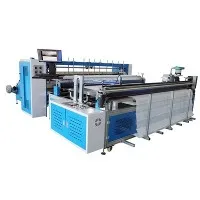
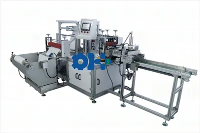
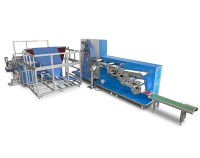
The surgical gown manufacturing machine has an automated and integrated production process. The precise production procedures and associated technical information are as follows:
Feeding raw materials:
Roll diameter and weight of non-woven fabric: Typically, raw materials are supplied as rolls that are 1000 mm in diameter and 50 kg in weight. By achieving smooth feeding, the damping anti-rotation mechanism keeps the conveying speed from becoming unmanageable due to inertia.
Tension control: To prevent wrinkling or stretching, the servo motor-driven tension control system makes sure the material maintains a steady tension throughout the conveying process.
Compounding and punching:
Punching process: Through the ultrasonic punching device, air holes or fixed holes are accurately punched on the non-woven fabric. The hole diameter and spacing can be adjusted according to product requirements.
Compounding technology: The ultrasonic compounding process is used to press multiple layers of non-woven fabric materials into one to form a composite fabric with protective performance.
Cutting and folding:
Cutting accuracy: The transverse cutter is driven by a high-precision servo motor, and the cutting accuracy can reach ±0.1mm to ensure the size consistency of surgical gowns.
Folding mechanism: The equipment is equipped with an automatic folding device, which can complete the folding of the cuffs, hems, and other parts of the surgical gown, and the folding width and angle are adjustable.
Welding and sealing:
Ultrasonic welding: The ultrasonic generator is used to generate high-frequency vibrations to make the non-woven fabric material frictionally welded at the molecular level to form a high-strength joint, and the strength of the joint is close to the material body.
Sealing treatment: Secondary welding of key parts such as cuffs and collars to ensure no gaps and improve protective performance.
Finished product output and inspection:
Automatic counting: The equipment is equipped with a photoelectric sensor to count the production quantity in real time to avoid missing or repeated counting.
Quality inspection: The visual inspection system is used to check the appearance quality of the surgical gown, such as whether the welding point is firm and whether the cutting edge is neat.
Finished product collection: Qualified products are sent to the collection area through a conveyor belt for subsequent packaging.