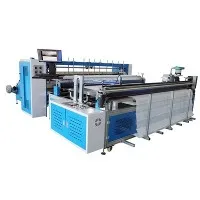
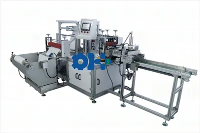
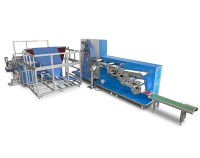
Traditionally, bedsheets require at least three steps: cutting the fabric at the cutting table, folding the fabric at the folding table, and sewing the fabric around the edges. Three stations, three workers, three time slots, plus hauling, waiting, middle alignment. Fully automated sheet makers compress these three steps into a production line less than 10 meters long. A piece of fabric is fed from one end and the finished product pops out from the other without interruption, movement or contact with the ground. How does it do that? It relies on the precise interconnection of three core mechanisms.
The first mechanism: rotary cutter head assembly-cutting is not "cutting," but "shaving."
Instead of scissors, the cutting unit of a bedplate maker is a set of rapidly rotating circular blades with a fixed length blade at the bottom. The circular blade can rotate at 3000 rpm and has a blade thickness less than 0.3 mm and can cut through fabrics such as tofu. The circular cutter cuts horizontally and the fixed length cutter cuts vertically. The two sets of knives move in sync with a servo motor, cutting the whole cloth into normal-sized sheets at a time.
The key is' at the same time '. Ordinary cutters first cut horizontally, then vertically, which requires the fabric to pause, move and reposition between cuts. The sheet-making machine's cutter sets of cutters are connected-the horizontal cutter descends, while the vertical cutter is in place to cross cut in 0.1 seconds, forming all four edges at once. The cut piece of fabric landed directly on the guide rollers of the next mechanism without any idle rotation.
The second mechanism: the guide fold system --the hinge is not "hinge," but "guide."
Cut pieces of cloth lay flat and folded into neat rectangles. Manual folding depends on hands and eyes; if folded incorrectly, it must be refolded. The machine adopts a set of guide rollers and folding plate with adjustable angle. When the fabric passes through the first set of guides, the guide folds inward by athird; when the fabric passes through the second set, the guide folds inward by a third, resulting in a standard three to four times shape.
The subtlety of the system lies its "speed matching." The rotation speed of the guide rollers is in strict sync with the feeding speed of the cutting head. As soon as the fabric came out of the cutter, the guide caught it without any pause. The angle of the folding plate is precisely controlled by the cylinder and the crease position is not more than 1 mm. Once folded, the edges of the fabric align automatically, with square corners that don't require manual "leveling" or "correction."
A third mechanism: Chain-type overlock unit locks - not "sewing," but"covering."
The edges of the folded fabric were still exposed cut edges that had to be locked. The print-making machine features a built-in high-speed chain-link sewing machine with a needle speed of up to 6000 stitches per minute. It uses 402 or 504 chain stitch, in which threads instantly form a loop into the fabric edge, completely sealing the original edges inside the needle.
The most complex design elements are "Synchronized Cutting and Superlocking." By the time the circular cutter makes its final cut, the overlock needle was ready at the edge of the fabric. The first movement of the fabric was pinpricked. In other words, the time difference between switching and relocking is zero. The traditional "cut and sew" process, which involves moving and waiting, has been completely cancelled here.
How do the three mechanisms coordinate seamlessly? through the central control system.
The whole machine is planned by PLC control system. The encoder measures the feed length of the fabric in real time, and photoelectric sensors monitors the arrival signals of each node. Signals indicating completion of cutting trigger the start of folding; signals indicating completion of folding trigger the start of the overlock sewing start; signals indicating completion of overlock sewing trigger counting output. Coordination between each step is precise to the millisecond level. The entire production line is similar to a conveyor belt assembly line, but it's more compact-because it only serves one piece of fabric, completing the entire process from raw material to finished product in one go.
As a result, cutting, folding and trimming are all done in one step. The three movements did not happen simultaneously; instead, under the command of the control system, the three agencies would compress what took three workstations, three people, and twenty minutes to become ten seconds, one person, and one machine. This is the most basic and central logic of industrial automation: eliminating all unnecessary pauses.
Jun 01, 2026
Cut, Fold, Curl A Dragon: How Does A Bedsheet Manufacturing Machine Complete A Dragon Process?
Previous
No Information
Send Inquiry
Product Categories
Latest Products