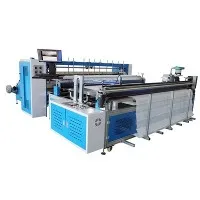
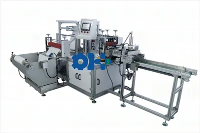
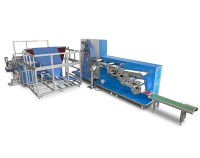
20 minutes versus 10 seconds – that's no exaggeration, it's a daily efficiency clash in home textile shop. To cut a standard sheet, a skilled tailor needs to lay the fabric, line, folding, cut and trim-all by hand for 20 minutes at a time. However, a fully automated sheet maker can produce a sheet every 10 seconds, and more than 300 sheets an hour from expansion to finished product output. Why? The answer lies in five seemingly illogical design features.
First: No "measuring," only "counting."
The most time-consuming part of cutting bed sheets by hand is not cutting, but measuring. Laying, folding, marking lines, folding, remarking lines-double checking dimensions to avoid cropping and bending. But the sheet making machine simply can't measure-it uses an encoder to "count." Each rotation of the feed roller records the pulse emitted by the encoder, indicating how many spins are equal to how many centimeters, with millimeter accuracy. You need a 250cm piece of paper and the machine automatically stops cutting at 250cm, exactly 250cm. This eliminates the need to draw lines, folding and checking, reducing the cutting time by 80% in this step alone.
Second: it's not a pair of scissors, but a row of blades that work simultaneously.
When you cut paper by hand, use scissors to cut from one end to the other, then flip it over to the other. The sheet-making machine's blades cuts horizontally and vertically at the same time-horizontally across the width of the blade tube, vertically down the length of the blade tube, and cutting all four sides at once. More impressively, high-end model also incorporates corner cutters, sewing machines, pillowcases and duvet covers. While others are still getting a head start, it has cut the whole thing.
Third: there is no "folding," just "guiding."
Manualfolding depends on feel, and after folding, you still need to flatten and align them by hand. The machine adopts the mechanical structure of guide rollers and folding plate --the fabric sheet is folded, flattened and output automatically through a set of precisely angled guide rollers with a crease position error of not more than 1 mm. Folding, pressing and alignment are seamless and do not require human intervention. Origami 30 seconds, in half a second.
Fourth: No "sewing," just "lock."
Manual overlocking is the slowest step, stitching along the fabric's edges and taking at least 5 minutes to lock. Print-making machine built-in a built-in high-speed overlocking mechanism, chain stitch speed up to 6000 pin/ minute. The edges of the fabric are immediately sewn shut at the moment it emerges from the cutter, with the cut and overlock completed at the same station. There is no "cut and sew" waiting, cropping is cropping, cropping is cropping.
Fifth: There is no "wait," just "continue."
Handmade bed sheets are a continuous process-cut, folded, trimmed, stacked, with free time between each step. On the other hand, the operation of a bed plate maker is a continuous, continuous process: unfolding, flattening, straightening, cutting, folding, curling, counting and stacking-eight processes connected to a single, uninterrupted production line. Fabric goes in one end and the finished product comes out the other, without stopping, without waiting, without touching the ground.
Together, These five seemingly "unreasonable" differences reveal the truth behind the 10-second difference between 20 minutes and physical work. It's not that machines are many times faster than humans, but that they essentially eliminate the "waiting" and "repetition" inherent in artificial processes. Hand-cut bed sheets are a craft, but in the face of efficiency, craftsmanship gives way to engineering. When a machine can replace 10 skilled workers an hour, you know the rules of the game in the industry have changed completely.
May 15, 2026
It Takes 20 Minutes To Cut A Sheet By Hand, 10 Seconds For A Machine: How Can A Sheet Making Machine Be So Fast?
Previous
Send Inquiry
Product Categories
Latest Products