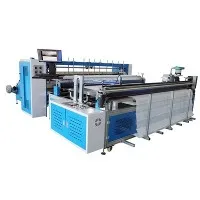
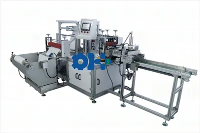
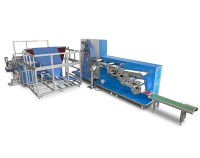
sheet roll has a high degree of automation, high efficiency, wide range of applications, environmental protection, in the medical, health, hotel, home and other fields show significant advantages, has become the production of modern nonwoven products of the core equipment. Here is a detailed analysis of its core advantages:
1.Efficient production: meeting large-scale demand
High-speed operational capability
Advanced models can reach speeds of up to 200 metres per minute and have a daily production capacity of more than 10 tonnes (based on 10 hours), far exceeding traditional manual or semi-automatic equipment.
For example, a 1.8-meter door width model can produce 3600 metres of sheet rolls per hour (based on a width of 200mm) and is suitable for emergency orders or mass supply.
Full-process automation
From material feeding, laminating, sectioning to winding, the process requires no human intervention, reducing labor costs (only 1-2 operators per shift).
Integrated PLC control system, production parameters (such as speed, tension, temperature, etc.) can be preset, realize one-key start and intelligent adjustment.
2.Cost optimization: Reduce comprehensive operating costs.
High utilization of raw materials;
Raw material loss rates ≤ 5% through precision cutting and scrap recycling systems are much lower than for conventional equipment (usually usually 10%-15%).
The feeder supports multiple sizes of raw paper (feeder φ60-φ1200mm), reduces the number of feeders and improves production continuity.
Energy consumption control
Using variable frequency motor and servo drive technology, energy consumption is 20% -30% lower than traditional models.
Optimize heating modules (e.g. infrared heating), shorten preheating time, reduce heat loss and further conserve energy.
Low maintenance costs
Modular design facilitates quick maintenance, and key components (such as bearings and cutters) can last up to 2 years, reducing downtime and maintenance time.
Equipped with self-diagnosis system, real-time monitoring of equipment status, early warning of malfunction, reduce the risk of sudden maintenance.
3. Quality stability: Ensure product consistency
Precision control technology
Tension control system: use servo motors or magnetic powder brakes, coil tension + -± 5%, prevent plate from loosening or breaking.
Deviation correction device: automatically adjust the position of raw material, ensure edge error ≤ ± 0.5mm, improve the aesthetic quality of the product.
Online detection: Integrated sensors monitor composite strength, moisture content and other indicators, provide real-time data feedback, adjust process parameters.
Process optimization
Ultrasonic welding technology: replaces traditional stitching, realizes seamless lamination, enhances the waterproofing performance (applies to medical bedspread).
Vertical strip pressure point design: the formation of uniform pressure point in the laminating process, not only to ensure strength, but also to avoid fiber damage, soft feel.
IV. INTRODUCTION Diversification: adapting to different needs
Flexible width and weight adjustment
Support the production of 0.5-3m wide sheet rolls, suitable for different occasions (such as cribs, large examination beds).
By adjusting the pressure or spray volume of hot rollers, the weight of the product is controlled at 30-200g/m2, balancing strength and breathability.
Functional integration capabilities
Multi-layer composite: Non-woven fabrics, PE films, absorbent cotton and other materials can be stacked to form multifunctional sheets (such as incontinence care mats).
Surface treatment: Supports embossing, printing, antistatic coating and other processes to add value to products (e.g. hotel templates).
Customized production
Modular design, can quickly mold replacement or adjust the parameters to achieve small batch, multi-variety flexible production.
For example, the same equipment can be converted into medical sheets, pet care mats or emergency rescue sheets to improve utilization.
V. Environmental protection and sustainability: responding to green trends
Degradable material support
With polylactic acid, wood pulp non-woven cloth and other environmental protection raw materials, production of degradable sheet rolls to reduce plastic pollution.
Some models are equipped with a recycling system to crush and re-granulate waste to achieve material recycling.
Energy efficient emission reduction design
Optimize equipment structure (e.g. light fuselage), reduce transport energy consumption and reduce carbon emissions.
Comply with international environmental standards (such as RoHS, REACH) to help companies pass environmental certification.
VI. INTRODUCTION Safety and personalised design
Safe operation
Equipped with emergency stop buttons, safety gratings, shield and other devices to prevent operators from touching rotating parts.
Comply with international safety certifications such as CE and ISO to reduce workplace injury risk.
Human-Computer Interaction Optimization
The touch-screen interface supports multilingual operations, simplifying parameter settings and troubleshooting.
Reserved data interface, can be connected with the MES system, achieve the traceability and management of production data.
VII. (b) Industry case verification advantages;
In the medical field, the introduction of the high-speed model in hospitals has led to a threefold increase in the efficiency of bedspread replacement and a 15% reduction in infection rate.
Hospitality: A hotel chain has cut the cost of bed sheets by 20% through bespoke production, while improving customer satisfaction (as sheets are softer and smell less).
Environmental projects: the company adopts the model of biodegradable materials, products certified by the EU eco-label, export volume increased by 40% year-on-year.
Sep 15, 2025
What Are The Advantages Of Non-woven Bed Sheet Roll Making Machine
Previous
Send Inquiry
Product Categories
Latest Products