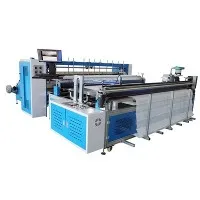
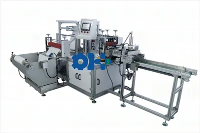
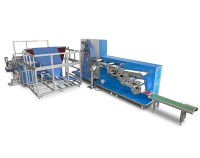
As automated processing equipment for non-woven fabrics, the core function of the surgical gown manufacturing machine is to transform non-woven fabrics into protective clothing products through ultrasonic welding, high-precision cutting, automated molding, and other technologies. Its application field has broken through the boundaries of the medical industry and covers multiple industries with strict requirements on cleanliness, protection, and production efficiency. The following is an analysis from three aspects: industry classification, typical application scenarios, and technical adaptability:
I. Core application industry
1. Medical and health field
Surgical gown/protective clothing production
Technical adaptation: Supports ultrasonic seamless welding of SMS composite materials (spunbond-meltblown-spunbond three-layer structure), with a seam strength of ≥15 N/cm, far exceeding manual sewing (about 8 N/cm), and effectively blocks blood and body fluid penetration (hydrostatic pressure ≥20 cm H₂O).
Typical cases: hospital isolation gowns, ICU protective clothing, operating room sterile clothing, etc.
Medical consumables matching
Product extension: It can simultaneously produce surgical drapes, disinfection wraps, instrument covers, etc., and quickly switch production specifications through modular molds.
2. Industrial safety protection
High-risk operation scenarios
Technical advantages: The equipment can process acid- and alkali-resistant coated non-woven fabrics (such as PE/PP composite materials) and produce protective clothing for the chemical and metallurgical industries, meeting the corrosion resistance requirements of GB 24540-2009.
Typical products: chemical protective clothing, dust-proof clothing, and electrostatic protective clothing (surface resistivity ≤10¹¹Ω).
Emergency material reserves
Production efficiency: High-speed models (35 pieces/minute) can quickly respond to emergency orders and meet the needs of disaster relief, epidemic reserves, and other scenarios.
3. Automobile and transportation fields
Interior parts manufacturing
Process adaptation: Laser positioning cutting technology is used to achieve special-shaped cutting of car seat covers and headrest covers (tolerance ±0.5mm), and the elastic band is fixed with ultrasonic spot welding technology, which increases production efficiency by 400% compared with traditional sewing.
Typical customers: Seat suppliers of BYD, Toyota, and other automakers.
Logistics and transportation protection
Product development: production of vehicle transportation covering film, aviation luggage compartment protective cover, and high-strength composite materials (weight 150 g/m²) to ensure wear resistance.
2. Expand application scenarios.
1. Civil consumer goods
Mother and baby and household products
Technology upgrade: through spunlace non-woven three-proof finishing (waterproof ≥ 130° contact angle), produce baby bibs, anti-fouling aprons, kitchen oil-proof covers, etc. to meet family cleaning needs.
Market data: data from a certain equipment manufacturer shows that the proportion of orders for mother and baby products has reached 20%, with an annual growth rate of more than 30%.
Travel and outdoor equipment
Product innovation: production of portable folding sleeping bags and waterproof tent linings, using ultrasonic welding to achieve seamless splicing, and the weight is 15% lower than traditional sewing products.
2. Public service industry
Hotel and catering support
Efficiency comparison: a fully automatic surgical gown manufacturing machine can produce hotel shower caps, chef uniforms, and napkin covers. The daily production capacity of a single device reaches 50,000 pieces, which is 50 times that of manual sewing.
Cost advantage: material utilization rate ≥ 90%, and the comprehensive cost is 25% lower than the sewing process.
Public transportation protection
Emergency response: During the epidemic, a bus group switched to producing driver protective clothing through surgical gown manufacturing machines. It only took 72 hours from equipment debugging to mass production, with a daily production capacity of 12,000 pieces.
3. Technical adaptability analysis
Industry demand, equipment solution, effect index
Medical-grade protection Ultrasonic seamless welding + antistatic coating Bacterial filtration efficiency (BFE) ≥99.9%
Industrial corrosion resistance Acid- and alkali-resistant composite material processing + multi-layer hot pressing sealing Strength retention rate after contact with corrosive liquid ≥85%
Automotive interior special-shaped cutting Laser positioning + visual correction system: special-shaped parts cutting accuracy ±0.3mm
Skin-friendly maternal and infant products Food-grade non-woven fabric + ultrasonic spot welding Formaldehyde content ≤16 mg/kg (in line with GB 18401 standard)
Low cost of public services Cross-layout algorithm + high-speed folding mechanism Material loss rate ≤8%, labor cost savings of 90%
4. Future trends and industry potential
Smart interconnection upgrade
Integrate the Industrial Internet of Things (IIoT) module to realize remote monitoring of equipment status and predictive maintenance of faults. A manufacturer has launched a smart model that supports 5G connection, reducing downtime by 60%.
Green manufacturing transformation
Development of biodegradable non-woven fabric processing technology, combined with an equipment waste heat recovery system, a single device can reduce carbon dioxide emissions by about 12 tons per year.
Deepening market segmentation
Develop customized models for emerging fields such as pet medical care and elderly care. For example, pet surgical gown equipment has achieved a cuff elastic adjustment accuracy of ±1mm, and the range of dog breeds covered has expanded by 30%.
Summary: The application boundaries of surgical gown manufacturing machines are extending from traditional medical protection to industrial safety, automobile manufacturing, civilian consumption, and other fields. Its core value lies in providing solutions that combine efficiency and quality for various industries through automation replacing manual labor, material technology upgrades, and flexible production capacity. In the future, with the coordinated development of equipment intelligence and material innovation, its market penetration is expected to further increase.