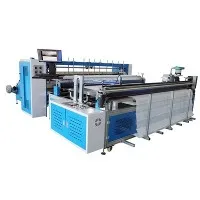
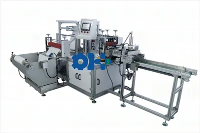
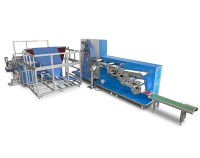
The basic functions of surgical gown manufacturing machines cover automated production processes and core technology applications. The core is to achieve efficient and precise manufacturing of surgical gowns from raw materials to finished products through integrated equipment and ensure that the products meet medical protection standards. The following is a detailed analysis of the functions:
1. Automated production process
Full process automated operation
From feeding to molding, the equipment can independently complete processes such as fabric feeding, automatic spot welding of belts, cutting of collars and cuffs, shoulder welding, and molding cutting without manual intervention.
Integrated production capacity: Taking the fully automatic protective clothing body manufacturing machine of Guangdong Wolcon Intelligent Technology Co., Ltd. as an example, its model WEK-MS006 can achieve continuous processing from fabric to finished products without manual operation in between.
Efficient production capacity
High output: The equipment output can reach 10-35 pieces/minute. For example, the model of Zhejiang Runtai Automation Technology Co., Ltd. can produce 23-35 pieces per minute, which significantly improves production efficiency.
Low manual dependence: Only one person is required to complete the entire process, and the automatic buttoning function can be optionally configured to achieve multiple uses of one machine.
2. Application of core technologies
Ultrasonic fusion technology
Seamless welding process: The ultrasonic generator converts high-frequency electrical energy into vibration energy so that the non-woven fabric material is frictionally welded at the molecular level to form a high-strength joint.
Improved protection performance: Compared with traditional needle and thread suture, ultrasonic welding avoids pinholes, has better airtightness, and can effectively block the spread of pathogenic microorganisms.
Intelligent control system
PLC precision control: The programmable logic controller (PLC) is used to realize the automatic operation of the equipment to ensure that the production parameters (such as speed and pressure) are stable and controllable.
Photoelectric detection function: Real-time monitoring of material position and quality, automatic deviation correction, and rejection of unqualified products to ensure product consistency.
3. Production quality control
Material adaptability
Compatible with a variety of materials: Support PE composite spunlace non-woven fabrics, SMS composite materials, etc., with a width of 100-220cm and a gram weight of 60-150 g/m² to meet different protection needs.
Constant tension control: The servo system is used to maintain the stable tension of material delivery to avoid dimensional deviations caused by wrinkles or stretching.
Multifunctional modular design
Customizable production: Design different flower wheels, molds, and cutters according to product requirements to achieve diversified processes such as hemming, welding, and cutting.
Cross-industry application: In addition to surgical gowns, non-woven products such as protective clothing, masks, car seat covers, shopping bags, etc. can also be produced to expand the use scenarios of the equipment.