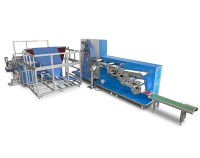
Underbelly cleaning: Wash your underbelly thoroughly with warm water and a neutral detergent (such as a medical-grade detergent) after each use to avoid any residual dirt or liquid medications.
Pipeline flushing: Flush the inlet, outlet and nozzle of a water treatment machine with tap water to prevent blockages or germs.
External wiping: Use a soft dry cloth to wipe down the outer casing of the equipment and avoid cleaning products containing alcohol or corrosive chemicals to prevent damage to PE surfaces.
Disinfection
Disinfect the bladder: According to the equipment instructions, use 75% medical alcohol or chlorine-containing disinfectant (e.g., 500mg/L effective chlorine solution) to soak the bladder for 10-15 minutes and then rinse it with sterile water.
Pipeline disinfection: Injecting disinfectant through a special disinfection interface, rinsing the pipeline system on a cycle to ensure that there is no dead-angle disinfection.
UV disinfection (optional): If the device has an UV lamp on, turn it on 30 minutes after daily use to assist with disinfection.
Consumables inspection
PE liner integrity: Check lining for damage, cracking or deformation. If there are anomalies, replace them immediately.
Seal ring status: Make sure the ring at the joint is not aging or falling off to ensure there is no risk of leakage.
Filter cleaning: If there is a filter on the device, clean or replace the filter core daily to prevent impurities from clogging the pipe.
2. Weekly maintenance
Deep cleaning
Demolition and cleaning: Remove removable parts (such as nozzles and shunts) and remove internal sediments with a soft brush.
Decontamination: If the water quality is poor, use citric acid or a special descaling agent and cycle through the pipes weekly to remove scale.
Functional testing
Flow pressure detection: Start the equipment to check that the nozzle flow is uniform and that the pressure is reaching a set value (e.g. 0.1-0.3MPa).
Temperature control verification: use thermometers to check that the temperature displayed in the equipment is consistent with the actual water temperature (error ≤±1°C).
Alarm system test: simulates water leakage or overload to determine if the device can be alerted in time and automatically shut off.
3. Monthly maintenance
Structural inspection
Pipeline connection: Check that all pipe joints are loose and tighten them with a wrench to the specified torque (e.g. 8-10 N.m.
Casing fixation: Ensure that the base and bracket of the equipment are not loose or deformed to prevent dumping during operation.
Electrical safety detection
Asphalt mixture ground resistance measurement: Use of ground resistance tester to ensure ground resistance ≤ 0.1 omega for equipment.
Insulation performance test: insulation resistance of power lines ≥ 1M (500V DC voltage) was measured with an ohmmeter.
Leakage protection test: Press the leakage protection switch test button to confirm that the device can cut off power supply in 0.1 seconds.
4. Quarterly maintenance
Performance calibration
Flowmeter calibration: Measure the actual flow of equipment using a standard measuring cylinder and compare it with the values shown. If the error exceeds ±5%, adjustments are required.
Pressure sensor calibration: Verify the accuracy of the sensor through a pressure calibrator and replace the faulty components if necessary.
Lubrication and maintenance
Lubrication of moving parts: Apply medical-grade silicone oil to pump shaft, valve shaft and other parts to reduce wear and tear.
Anti-aging treatment of PE linings: Special PE protectors are sprayed on non-contact areas to slow material aging.
V. Annual maintenance
Overhaul
Pump removal inspection: professional removal inspection pump, inspection the impeller and bearing wear and tear, replacement of seals.
Circuit board detection: using an oscilloscope to check the stability of control board signals, repair cold welding or oxidized contacts.
PE liner life assessment: Assess whether the lining needs to be replaced in advance (usually 1-3 years) based on frequency of use and water quality.
Update Safety certification
Contact a third party agency to conduct electrical safety (e.g. IEC 60601-1) and electromagnetic compatibility (EMC) tests to ensure compliance with the latest standards.
VI. INTRODUCTION Notes on maintenance
Power outage: All maintenance equipment must be turned off and "No Parking" signs put up before the outage.
Waterproof measures: When cleaning the motor or control panel, avoid splashing on the motor or control panel and use a waterproof cover for protection.
Record keeping: Complete the Equipment Maintenance Record Form after each maintenance, including the maintenance date, contents, replacement parts and operator signature.
Manufacturer support: When experiencing complex problems (such as control panel errors), contact the manufacturer's technical support in time to avoid the warranty being invalidated by removal.
Aug 01, 2025
What Is The Daily Maintenance Of PE Hydrotherapy Machine?
Send Inquiry
Product Categories
Latest Products