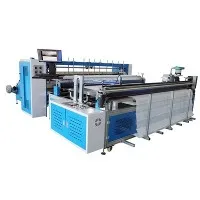
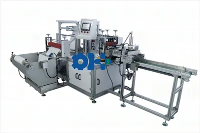
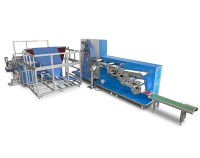
The production process of surgical gowns must strictly follow medical standards, and sterility, protection, and comfort must be ensured in every link from material selection to finished product packaging. The following are standardized production processes and key technical points:
1. Material selection and pretreatment
Core material standards
Main materials: Medical-grade polyester fiber, SMS composite material (spunbond-meltblown-spunbond three-layer structure), or spunlace non-woven fabrics are preferred, and the following indicators must be met:
Impeccability: hydrostatic pressure ≥ 20 cmH₂O (ASTM F1670 standard)
Filtration efficiency: 0.3 μm particle blocking rate ≥ 99% (ISO 16603 standard)
Antistatic property: surface resistivity ≤ 10¹¹ Ω (IEC 61340-5-1 standard)
Accessories: white four-eye button, medical-grade sewing thread (breaking strength ≥ 15 N), pure cotton straps (for fixation).
Material pretreatment
Sterilization: Ethylene oxide (EO) sterilization or gamma ray irradiation sterilization ensures that the initial contamination bacteria ≤10 CFU/g.
Functional finishing: Three-proof finishing (waterproof, alcohol-proof, blood-proof) for spunlace non-woven fabrics, contact angle ≥130°
II. Cutting and plate making
Pattern design
Ergonomic design: According to the body shape data of medical staff, four sizes of S/M/L/XL are set, and the size tolerance of key parts is ±0.5 cm.
Functional zoning:
The front adopts a double-layer protection design (outer SMS + inner PE film).
The cuffs adopt an elastic closing structure (rebound rate ≥85%).
The collar is a three-dimensional fitting design (contact pressure with the neck 5-10 g/cm²).
Precision cutting
Use a laser cutting system with a positioning accuracy of ±0.1 mm.
After cutting, the scraps need to be removed to avoid fiber shedding and contamination.
III. Sewing and assembly
Sewing process
Sewing parameters:
Stitch density: 8-10 needles/3cm
Needle Distance: 3.0-3.5mm
Seam width: 1.2-1.5cm
Key process:
The neckline uses a hemming process (seam strength ≥45N).
Seams are hot-pressed and sealed (seal width ≥8mm, peel strength ≥15 N/cm).
Quality inspection
Physical inspection:
Tensile strength: ≥80N in warp and weft
Tear strength: ≥15N
Microbial detection: total bacterial colony count ≤20 CFU/g, total fungal colony count ≤10 CFU/g
IV. Post-processing and packaging
Post-processing process
Ultrasonic cleaning: remove particles generated during sewing (particle size > 5 μm, particle removal rate ≥ 99.9%).
Sterilization verification: use a biological indicator (Bacillus stearothermophilus) to confirm the sterilization effect.
Packaging specifications
Primary packaging: medical dialysis paper + polyester film composite packaging, oxygen permeability ≤1cm³/(m²·24h·0.1MPa)
Secondary packaging: use a sterile barrier system to meet the ISO 11607 standard.
Labeling requirements: sterilization batch number, expiration date (≥3 years), instructions for use, and CE/FDA certification mark
V. Key technical parameter control
Control items Technical requirements: test methods
Particle filtration efficiency (PFE) ≥99% @ 0.1 μm TSI 8130 automatic filter material tester
Blood penetration resistance ≥16 kPa (120 mmHg) ASTM F1862 standard
Breathability 5-15 mm/s (Gurley method) ASTM D726 standard
Fluorescent residue No visible fluorescent spots UV-365nm wavelength detection
VI. Special scene adaptation
High-risk surgery: Use a positive-pressure protective clothing structure equipped with an airtight zipper and exhaust valve (leakage rate ≤0.5 L/min).
Minimally invasive surgery: cuff-integrated elastic light guide fixing ring (tensile strength ≥30 N)
Pediatric surgery: Develop cartoon pattern antibacterial coating (silver ion release 0.5-1.5 μg/cm²).