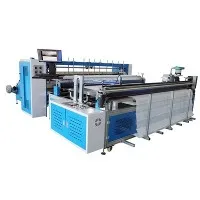
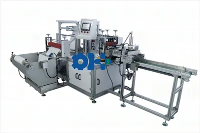
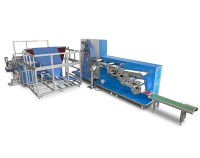
The sheets you sleep in every day have probably never been touched. From a roll of raw fabric to the perfect square, neatly trimmed bedspread on your bed, the process is completed in one go by a sheet making machine. What happens in between? It's a lot more complicated and a lot faster than you imagine.
Step 1: Unfold and Flattening-First, "iron" the fabric.
Bedspread machines start with a roll of raw material weighing hundreds of kilograms, usually pure cotton or a polyester cotton blend, and range in width from 2.5 metres to 3.2 metres. The machine's first task is to unroll, flatten and correct the fabric at an even speed. The correction system uses photoelectric sensors to detect the edge position of the fabric in real time. If the deviation exceeds 2 mm, the correction roller is immediately fine-tuned to ensure that the surface of the fabric is always directly under the cutting head. This step may seem simple, but tension control of the fabric directly determines the accuracy of subsequent tailoring-too much tension can stretch and distort the fabric, while too little can lead to creases and dislocations. It all depends on millisecond coordination between servo motors and magnetic powder brakes.
Step 2: Precision cutting-one cut, no more than 1mm.
Flat fabrics go to the core: cropping. Print-making machine equipped with high-speed rotary cutter head, speed up to up to 3000 rpm. Combined with a tool with a fixed length at the bottom, the whole fabric can be cut into standard sheet sizes in one pass. Taking the 250cm x 250cm edition commonly used in hotels as an example, the length of cloth fabric feeding accurately measured by an encoder and the cutting accuracy is controlled to ±1mm. That's why hotel paper is always the uniform size-not measured by workers, but "counted" by coders.
More importantly, cutting is not a one-off process. Automatic bed-plate making machine usually integrates multiple cutting heads and can be used for transverse, longitudinal, angular and seam cutting. It can cut the main body of sheets, pillowcases and duvets at the same time, all in one go, and is dozens of times more efficient than manual labor.
Step 3: Folding and molding-Folding a piece of fabric into a sheet.
The cut fabric pieces was still in place and the next step is folding. The machine uses a set of guide rollers and folding plates to fold the cropped fabric into neat rectangles or squares in a preset pattern. The position, number and direction of creases can be adjusted depending on the type of sheet-the flat sheet folds twice, fitted sheets folds three times with elastic bands and duvet folds four times with pre-existing openings. This step relies entirely on precise alignment of the guide roller's angle and speed, resulting in folding sheets aligned with diagonal, sharp edges and no crookedness.
Step 4: Superlock and Sew-Give sheets a "bulletproof vest."
After folding, the sheets still have rough cut edges that must be locked. The Bed Maker has a built-in overlock sewing mechanism that uses high-speed chain stitch to wrap and stitch the fabric edges to achieve a stitch density of 4 to 5 stitches per centimetre. This prevents unraveling without affecting the feel of the fabric. High-end models can also do frills, face stitching and labeling at the same time. From fabric to finished product, sheets are never touched or handled by operators.
Step 5: Count and stack-Last step: Stack sheets neatly.
Finished bed sheets are output through a conveyor belt, which is automatically counted by a photoelectric counter. Once the set value is reached, the paper will be automatically stacked or packaged. The entire production line can be operated by a single person from start to finish, producing 200 to 600 bed sheets an hour, the equivalent of 8 to 10 skilled sewing workers.
Therefore, turning a piece of fabric into a sheet goes through six stages: unfolding, correcting deviations, cutting, folding, curling and counting. Each step represents a major leap in manual sewing accuracy. Your sheets are neat, evenly sized and beautifully sewn, not because anyone can make them, but because the machine never jiggles.
May 01, 2026
What Happens When A Piece Of Fabric Turns Into A Sheet? — A Complete Sheet Molding Machine.
Send Inquiry
Product Categories
Latest Products